This is not first-aid training and it is not medical advice. In an emergency, call 999 or 112. The actions described here are practised in a course (PSC1, SST or tourniquet training). A diagram helps you understand, but it does not replace training.
Life-threatening emergency
Arterial hemorrhage: about 30 seconds
Placing a tourniquet is an act of extreme emergency. The time scale taught is about 30 seconds: beyond that, a hemorrhage can be fatal. When the blood is spurting, there is no time to open instructions. The tourniquet is effective when the bleeding stops, not when it feels comfortable. An effective tourniquet is very painful. Contrary to a common belief, that does not mean the limb will be amputated. The injured person must be seen by a doctor within 6 hours, in order to limit that risk. This action is prepared in advance, in a calm moment, and repeated regularly. Without that repetition, it is no longer remembered when you have to act quickly.
Order of priorities
SAFE MARCHE RYAN
A memory aid to keep an order when a situation deteriorates. It is not a medical consultation, nor first-aid training. If the danger is still present, the priority is to get to safety and raise the alert.
SAFE
Before touching the injured person
- S
Stop the danger
The danger may be a fire, traffic or an attacker. Switch off what you can, move away and get to safety. If the threat continues, do not intervene: move away and call the emergency services.
- A
Read the scene
See how many people are injured, what may still be dangerous, and which way out there is. This first look is there so that you do not act at random.
- F
You, out of danger
A second casualty helps no one. Gloves if you have them, a look all around, do not lie down on the roadway.
- E
Assess (ABC)
Is air getting through, is there active bleeding, is the person conscious? Then call 999 or 112 and give a short report: who is injured, where you are, what happened and how many people are involved.
MARCHE
The life-saving priorities
- M
The blood
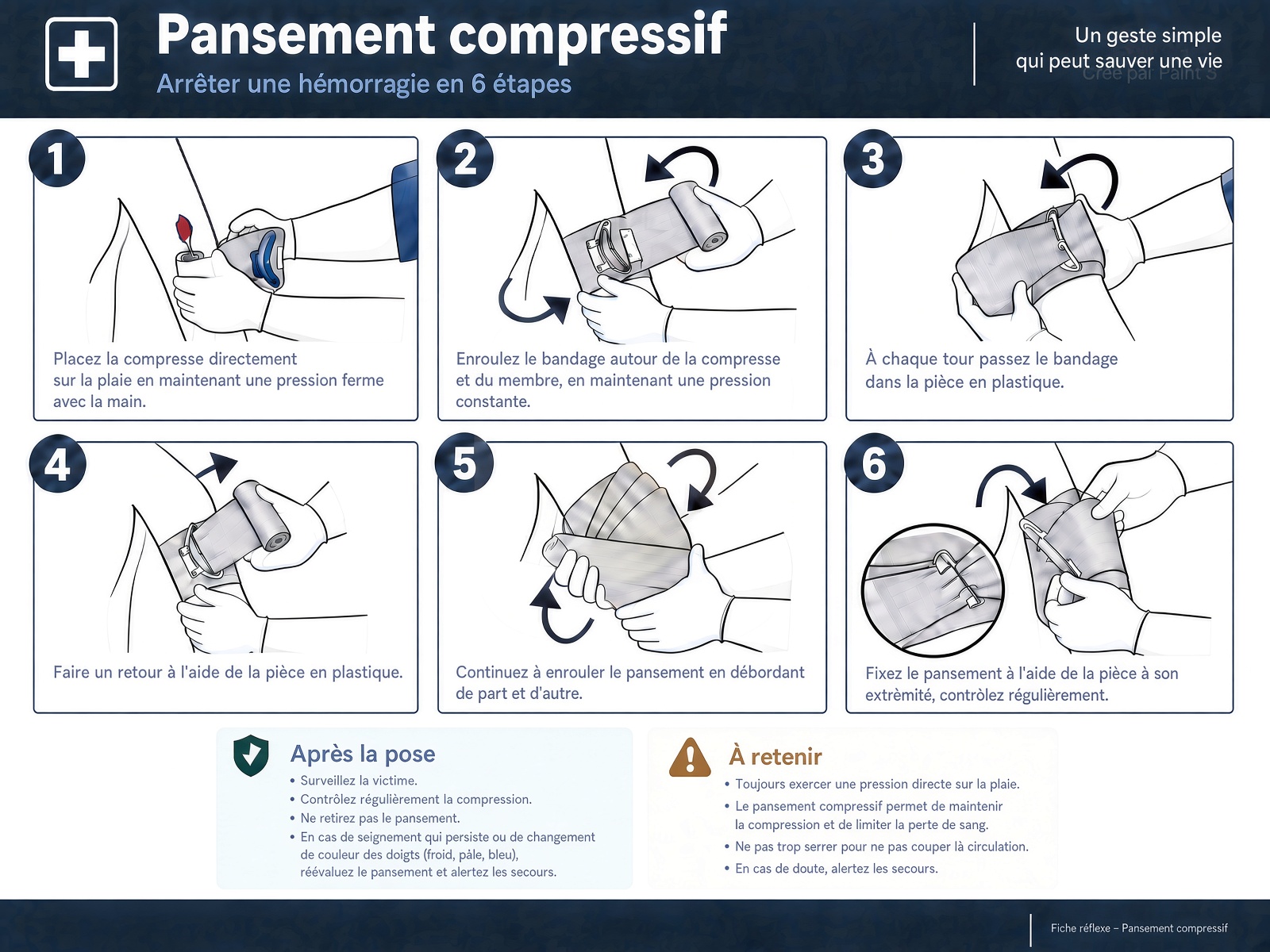
Massive hemorrhage first. Direct pressure, then a pressure dressing: pad on the wound, bandage around, back and forth in the pressure bar, clip. Tourniquet if the limb is spurting or soaks everything: high, strap, windlass until it stops, time. A second tourniquet if needed. Do not remove it. A doctor within 6 hours.
- A
The airway
Clear the mouth (blood, foreign body). Unconscious and breathing: recovery position. Unconscious and not breathing: alert, chest compressions according to your training.
- R
Breathing
Chest, distress, whistling. Conscious casualty: semi-sitting if it helps. Do not remove an impaled object.
- C
Circulation
Pulse, pallor, cold. Lay the person down, legs raised if there is no obvious trauma. Cover them.
- H
Head / hypothermia
Head: do not move the person after a violent impact, except for immediate danger. Cover them: the cold kills after the blood.
- E
Evacuation
You prepare; the emergency services take them. Report passed on, tourniquet time stated clearly. You do not “finish the journey” with an unstable casualty.
RYAN
Then, without letting go of the essential
- R
Reassess
Go through MARCHE again. Tourniquet still tight? Dressing saturated? Consciousness?
- Y
Eyes
Injured eye: do not press, cover without compression, both eyes if possible to limit movement.
- A
Ease the pain
Immobilize, reassure, do not give anything to drink. No improvised painkiller if surgery is possible.
- N
Clean / protect
Cover cleanly. No harsh disinfectant in a deep wound. Wait for the emergency services.
Actions, step by step
Understand the action before you need it
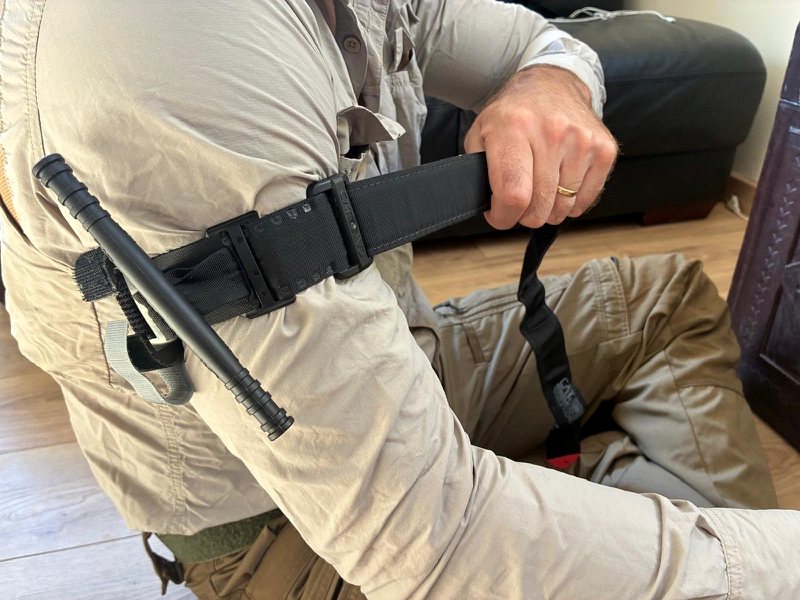
The photos show a commercial tourniquet, in order: prepare it in advance on the thigh, fold it like an accordion, place it, tighten it until the bleeding stops, lock it and write down the time. The pressure-dressing sheet is the version already approved, and it is shown as it is. Looking at a diagram does not mean you can perform the action on the day it is needed. Get to know your equipment and repeat these actions in a calm place, before any emergency. That repetition builds automatic responses. When a real situation brings stress and haste, an action you have already practised is easier to carry out.
Tourniquet
When: Hemorrhage of a limb, arm or leg. Spurting, a pool that grows, a soaked dressing, amputation. About 30 seconds. An effective action is very painful: that is the criterion, not a flaw.
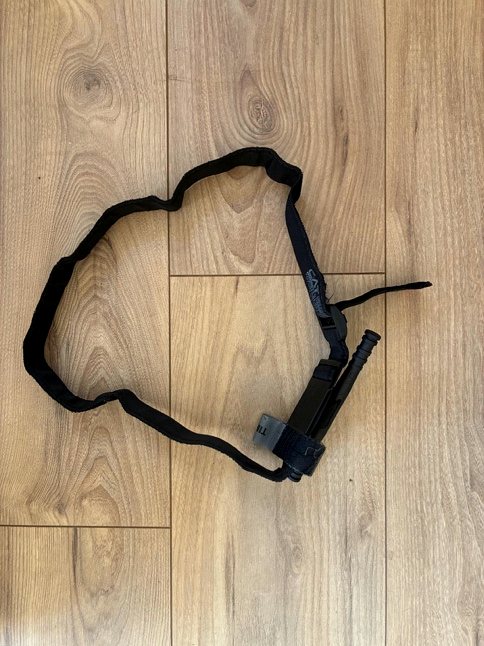
Step 01
The equipment
Strap, buckle, windlass and the light hook-and-loop band, the one on which the time is written. Before an emergency, take the time to recognise each part. On the day the blood is spurting, it is no longer the moment to discover the equipment.
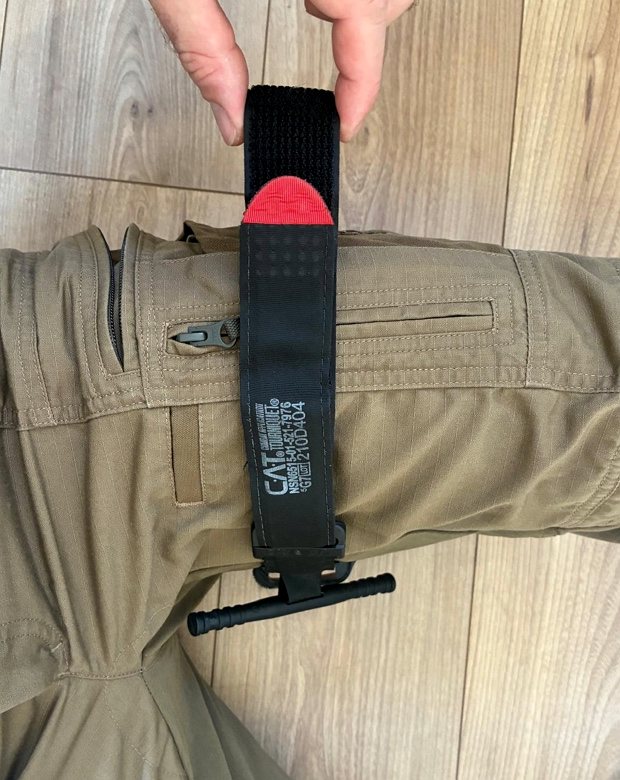
Step 02
Preset
Preset the width on your largest limb: the thigh. On the day of the emergency, the circumference is already right.
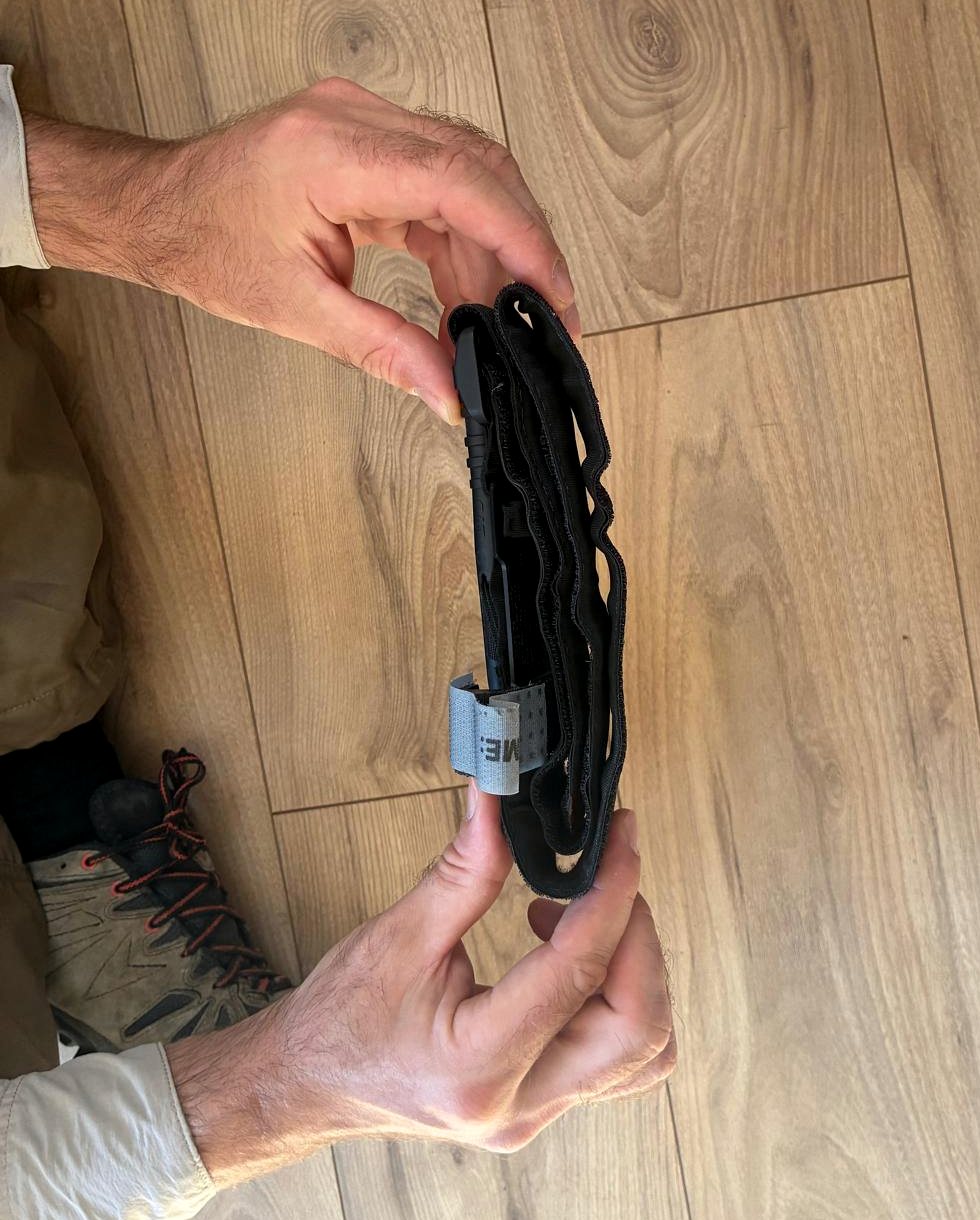
Step 03
Accordion
Keep that width. Fold it accordion-style — do not roll it on itself. A soft elastic band, or a dedicated pouch. It must deploy in one movement.
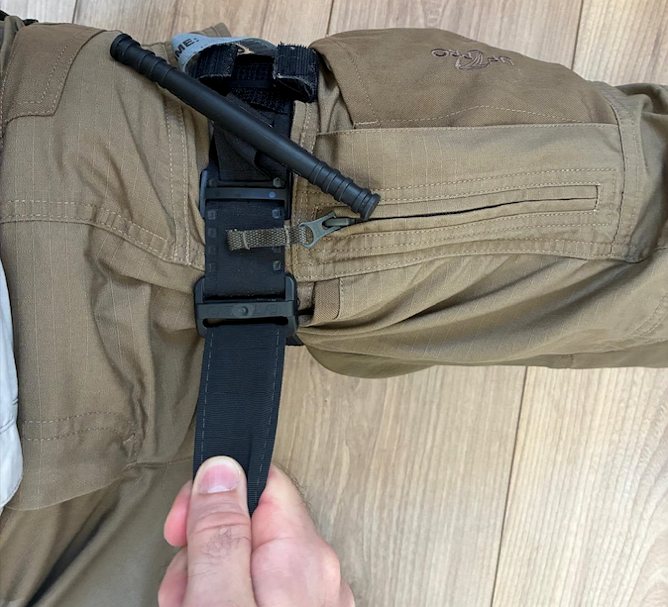
Step 04
Thigh — place
Pass it over the foot. High on the thigh, never on the knee. Pull the free strap, lock it with the hook-and-loop.
Step 05
Arm — place
Same action: pass it over the hand, as high as possible on the arm, not on the elbow. Strap, then hook-and-loop.
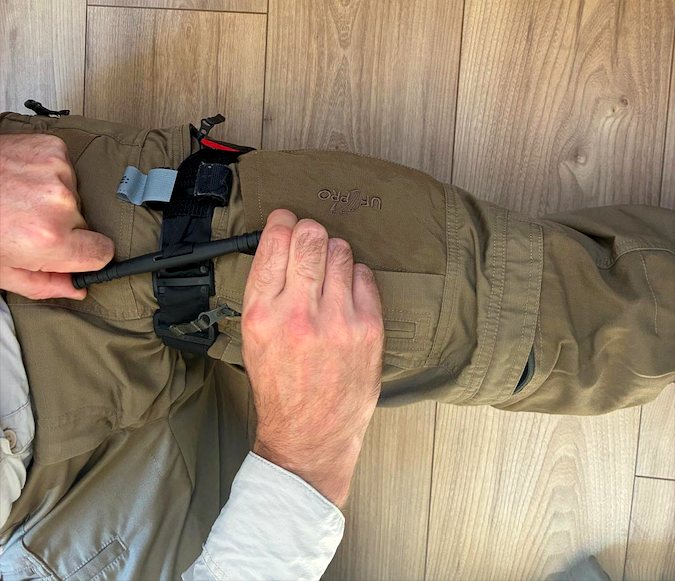
Step 06
Thigh — tighten
Turn the windlass until there is sharp pain and the bleeding stops. A comfortable tourniquet does nothing.
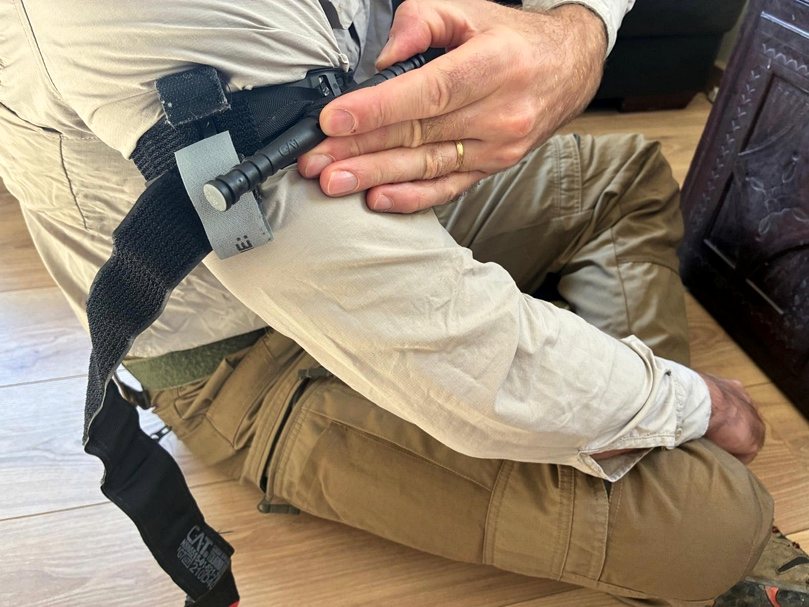
Step 07
Arm — tighten
Same criterion on the arm: you turn it for as long as it bleeds. Effectiveness is judged by the bleeding stopping.
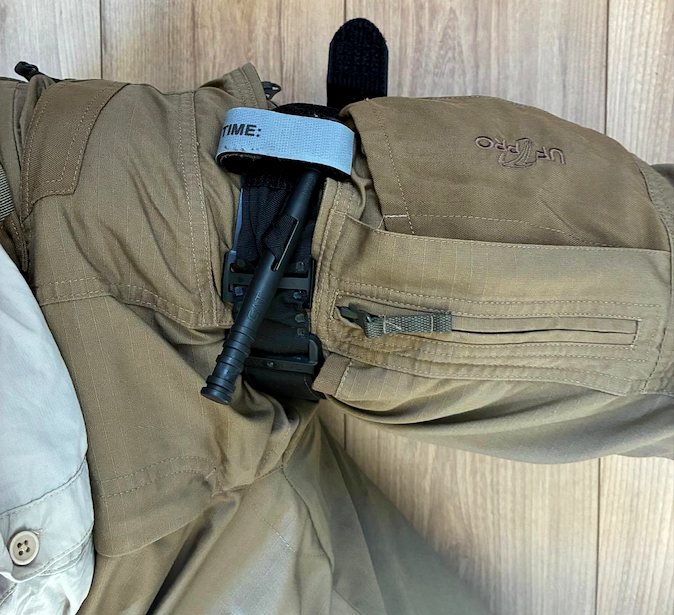
Step 08
Thigh — lock, time
Two clips take the windlass. The grey hook-and-loop secures it. Write the time on the light-colored part.
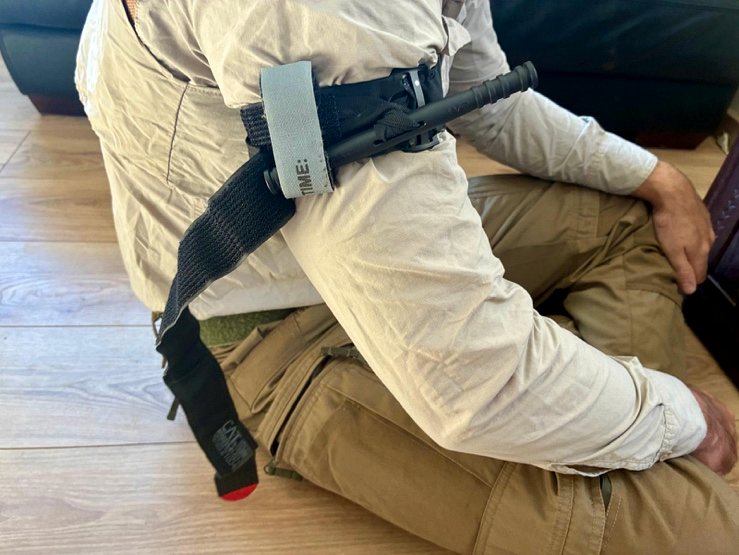
Step 09
Arm — lock, time
Same locking. A readable time. You do not remove the tourniquet. Check that the bleeding has stopped. If it continues: a second one, without removing the first.
Not on the neck. Not on a joint. Do not leave it loose “so it does not hurt”. Do not remove it. If it is still bleeding, a second tourniquet, higher, without removing the first. A doctor within 6 hours — an effective tourniquet does not by itself cause amputation.
Reflex sheet — Pressure dressing
Emergency health pack
Vehicle kit
- Dedicated tourniquet (practiced), within reach — not under the trunk
- Pressure dressing, gloves, survival blanket
- Seat-belt cutter (on the key ring): belt jammed after an impact
- Vest, warning triangle, lamp, water, charger
Included with your report
Emergency health pack
They recall the order of priorities and the actions already approved, without replacing first-aid training.
Included in every full personalized report, the Emergency health pack brings together practical sheets to prepare better for certain emergency situations.
The Emergency health pack replaces neither a doctor nor the emergency services. It is a practical support for preparation and response to emergency situations.
- Reflex sheet — Pressure dressing
- Emergency kit
- Family medical sheet
- Contacts and message to the emergency services
- Children
- Vulnerable people
- Household organization
- First responses
File 129 € incl. VAT
The report goes further into this preparation
This page sets out reference points, free of charge. Any follow-up questionnaire is also free. The full personalised report, at 129 €, includes the Emergency health pack. The pack is not a separate option, and it is not medical advice.
This information is meant to help with preparation and replaces neither the advice of a health professional nor the intervention of the emergency services.